
Yes, press releases can help SEO, but not in the way most people think. Press releases don’t boost rankings by themselves, and Google does not give “SEO points” for publishing them. However, press releases can indirectly improve SEO when they lead to real news coverage, brand mentions, trusted backlinks, and increased search visibility.
Here’s the simple truth:
- A press release alone does not increase rankings.
- A well-written, newsworthy press release can lead to journalists covering your story.
- That coverage can generate trusted backlinks, referral traffic, brand authority, and online visibility, all of which support stronger SEO.
So press releases aren’t a direct SEO trick, but they are a strategic tool that strengthens brand authority, which helps search performance over time.
Key Takeaways About Press Releases and SEO
-
 Press releases don’t directly improve rankings, but they support SEO when they lead to genuine media coverage.
-
Google ignores most links in press releases because they are usually no-follow or syndicated.
-
The real SEO value comes from journalists, bloggers, and publications who pick up your story and link to your website naturally.
-
Press releases help build brand authority, credibility, and trust signals, which support long-term SEO growth.
-
Not every announcement deserves a press release. Only newsworthy stories perform well and attract real coverage.
-
Overusing press releases or using spammy distribution sites can hurt your brand reputation (and wastes money).
-
When used correctly, press releases become part of a Digital PR strategy, which is one of the most powerful modern SEO methods.
-
Small businesses can benefit when they tie press releases to product launches, milestones, partnerships, events, or new data reports.
-
The key is quality: a clear angle, a real story, valuable information, and the right distribution.
How Press Releases Influence SEO and Online Visibility
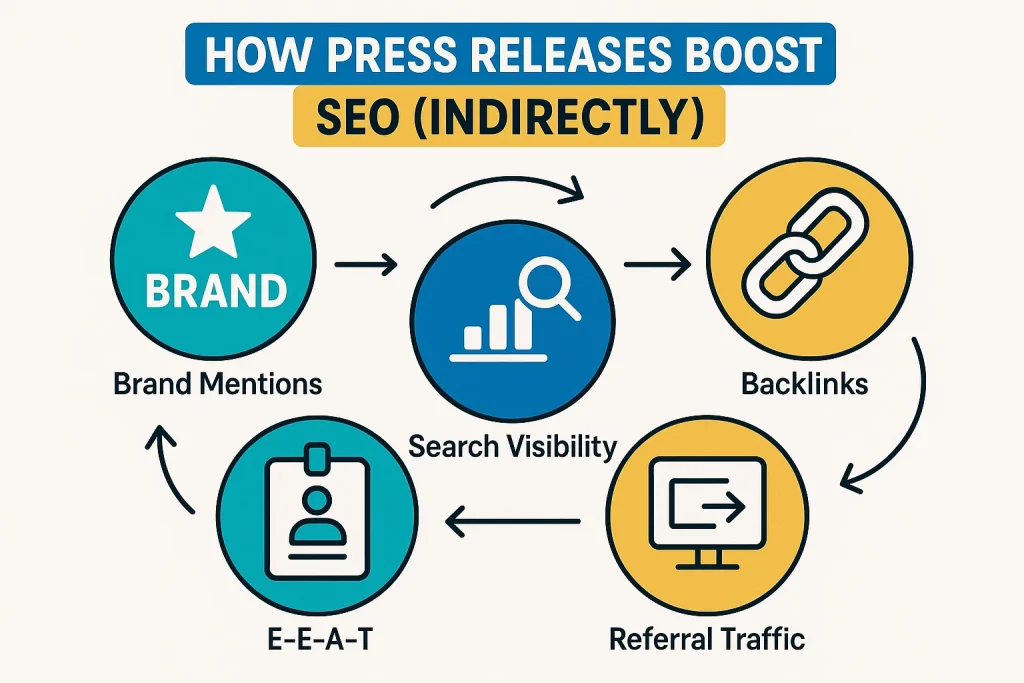
“How Press Releases Boost SEO (Indirectly)” + mini labels under each icon
Press releases influence SEO through indirect but powerful signals that help search engines trust your brand more. While a press release itself won’t move rankings, the visibility it creates can strengthen your entire SEO ecosystem.
A high-quality press release can impact SEO in these ways:
1. Brand Mentions Build Trust Signals
Even if a publication doesn’t link to you, a mention of your brand, product, or founder helps search engines understand:
- Who you are.
- What you do.
- Why do people talk about your company?
These “implied links” support your online authority and strengthen your brand presence in search results.
2. Media Coverage Generates High-Authority Backlinks
When journalists cover your press release:
- They may link to your website.
- They may reference your data.
- They may cite your founder or company.
These editorial backlinks hold real SEO value, unlike the syndicated links inside the press release itself.
3. Increased Visibility Leads to More Search Queries
When your news appears on trusted platforms:
- More people search your brand.
- Google sees your brand as more credible.
- Higher branded search volume helps long-term rankings.
This is one of the most underrated SEO benefits of press releases.
4. Press Releases Strengthen E-E-A-T
Google cares about:
- Expertise
- Experience
- Authoritativeness
- Trustworthiness
Appearing in credible news sources boosts all four signals and increases your likelihood of ranking in competitive niches.
5. Referral Traffic Improves User Signals
Press releases often drive traffic from:
- News websites
- Industry blogs
- Local publications
Users who stay longer, explore multiple pages, or convert send positive behavioral signals that support SEO.
Did You Know?
A press release with a strong news angle has 10x more chance of being picked up by journalists than a promotional or sales-focused release.
Why Press Releases Often Fail When Used Incorrectly
Most businesses publish press releases hoping for “instant backlinks” or “quick rankings,” but this approach rarely works. Press releases fail not because they’re outdated, but because they’re used the wrong way.
Below are the most common reasons press releases deliver zero SEO value:
1. The Topic Isn’t Newsworthy
Many businesses push out releases about:
- Minor updates
- Routine internal changes
- Generic announcements
Journalists ignore these because they don’t provide value to readers.
A press release must answer the question: “Why should the public care?”
If the story isn’t strong enough, no newsroom will pick it up.
2. Overuse of Mass Distribution Sites
Cheap distribution services promise:
- 200+ backlinks
- Guaranteed placements
- Fast SEO results
But those “placements” are usually:
- Low-quality websites
- Syndicated duplicates
- No-follow links
- Zero traffic sources
These links offer no real SEO benefit and sometimes damage credibility.
3. Keyword Stuffing Makes the Release Look Spammy
Some companies still insert:
- Exact-match keywords
- Repetitive anchor text
- Over-optimized sentences
This not only hurts readability but also signals to journalists that the release is written for SEO, not news.
4. Lack of a Journalist Angle
Press releases often fail because they sound like ads.
Journalists want:
- Data
- Insights
- Trends
- Real stories
- Human interest angles
If your release sounds promotional instead of informative, it goes unread.
5. No Follow-Up With Media
Publishing a press release is not the end, it’s the beginning.
Successful companies:
- Send personal pitches
- Reach out to targeted reporters
- Offer quotes and additional data
Without this, even great press releases get buried.
6. Poor Timing or Irrelevant Context
Sending a release during:
- Major holidays
- Big national news
- Election cycles
- Industry shifts
…often causes your story to get lost. Timing matters more than many businesses realize.
Big Mistake to Avoid:
If you only rely on “press release distribution sites,” you’ll never see real SEO results.
Journalist pickup, not syndication, creates the actual value.
Real SEO Benefits of a Well-Executed Press Release
When a press release is written with a strong news angle and distributed correctly, it can create strategic SEO advantages that most brands overlook. These benefits come from real media coverage, not from the press release itself.
Below are the most meaningful SEO benefits of a properly executed press release:
1. High-Authority Editorial Backlinks
The biggest SEO win is earning links from:
- News publications
- Industry websites
- Local or national media
- Bloggers or analysts
These backlinks are:
- Natural
- Contextual
- High-authority
- Trusted by Google
They outperform low-quality backlinks by a huge margin.
2. Increased Brand Authority in Search
Appearing on credible sites enhances how Google views your brand.
It improves:
- Trust signals
- Online reputation
- Expertise perception
This helps your website rank more consistently in competitive niches.
3. More Branded Search Queries
When people see your brand in the news, they search for:
- Your company name
- Your product
- Your founder
- Your service
A rise in branded searches is strongly associated with improved long-term SEO performance.
4. Higher Referral Traffic From News Sites
People reading about your story may click through to your website.
This traffic often performs well in terms of:
- Time on page
- Pages viewed
- Conversion potential
Those user signals help Google understand your content quality.
5. Stronger E-E-A-T (Expertise, Experience, Authoritativeness, Trustworthiness)
Press coverage proves that your brand:
- Has authority
- Is recognized in your industry
- Produces noteworthy work
This aligns with Google’s EEAT guidelines and helps search visibility.
6. Better Online Visibility Across Multiple Channels
A single strong press release can start a chain reaction:
- News stories
- Social shares
- Journalist mentions
- Industry feature articles
- Podcast invitations
- Additional interviews
All of these contribute to stronger SEO momentum.
7. Higher Local SEO Visibility
For local businesses, press releases can help:
- Local news sites cover your story.
- Google understand your service area.
- Strengthen NAP consistency.
- Build trust in your community.
Local publications often hold surprisingly strong SEO value.
Did You Know?
Editorial backlinks earned from news coverage are considered one of the strongest off-page SEO signals, outperforming most other link types.
Press Release vs Digital PR: Which Supports SEO Better
Press releases and digital PR are related, but they aren’t the same thing. Understanding the difference helps you choose the best strategy for long-term SEO success.
Press releases are mainly used to announce news, while digital PR focuses on earning high-authority backlinks and brand exposure.
Here’s a clear breakdown:
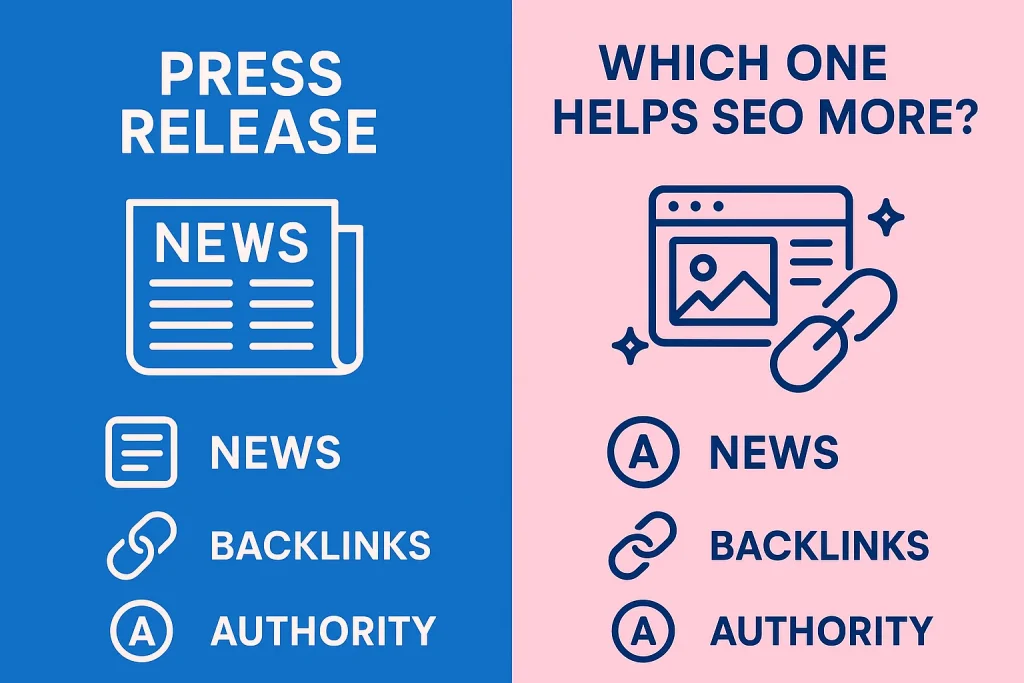
Left: “Press Release” Right: “Digital PR” + Subtext: “Which One Helps SEO More?”
Comparison Table: Press Release vs Digital PR
| Aspect | Press Release | Digital PR |
| Primary Purpose | Announce news or updates | Earn editorial backlinks and media coverage |
| SEO Value | Indirect, depends on pickup | High, direct SEO benefit |
| Link Type | Mostly no-follow, syndicated | Natural editorial backlinks |
| Distribution | Newswire platforms, mass distribution | Targeted outreach to journalists, bloggers, publications |
| Cost | Medium | Medium to High |
| Content Style | Formal, structured | Creative, story-driven |
| Examples | Product launch, partnership announcement, event notice | Data studies, expert commentary, industry insights, viral stories |
| Best For | Brand awareness and public documentation | Rankings, authority, and organic traffic growth |
Which One Helps SEO More?
Digital PR is significantly stronger for SEO because it focuses on:
- Earning natural backlinks.
- Building authority.
- Securing long-term visibility.
However, a press release becomes powerful when:
- The topic is newsworthy.
- Journalists pick it up.
- It leads to editorial coverage.
In other words, press releases support digital PR, and both together create a strong SEO ecosystem.
Pro Tip
If you want SEO impact, don’t rely on a press release alone.
Combine it with targeted reporter outreach, personalized pitches, and relevant data — that’s where the real value is.
How Press Release Backlinks Actually Work
Many people misunderstand how backlinks from press releases affect SEO. The truth is simple: the backlinks inside a press release rarely have direct ranking power, but the backlinks earned because of the press release can be extremely valuable.
Here’s how it really works:
1. Most Press Release Links Are No-follow
Newswire platforms (like PRWeb, EIN, BusinessWire, etc.) add no-follow or redirected links.
This means:
- They don’t pass PageRank
- They don’t boost domain authority
- They don’t directly improve rankings
Google has publicly stated that syndicated press release links should not be used as a link-building tactic.
2. The Real Value Comes From Journalists Covering Your Story
A strong press release acts as a starting point.
If reporters find your story interesting, they may:
- Write about it
- Link to your website
- Mention your brand
- Feature your data
These backlinks are:
- Natural
- High-authority
- Contextual
- SEO-valuable
This is where the indirect SEO power begins.
3. Not All Media Coverage Includes a Link — But Mentions Still Matter
Sometimes journalists mention your business without linking.
These “implied links” still help Google understand:
- Your brand relevance
- Your industry presence
- Your authority
They support ranking signals even without a clickable link.
4. Press Release Backlinks Help With Indexing and Discovery
Even no-follow links can help search engines:
- Find new pages faster
- Discover new URLs
- Understand entity relationships
This improves crawling efficiency and supports a stronger technical SEO foundation.
5. Press Releases Contribute to Your Backlink Profile Diversity
Google likes natural backlink profiles.
Press releases add:
- Branded anchors
- No-follow diversity
- Contextual references
Together, these improve your domain’s trust profile in a healthy, balanced way.
Did You Know?
Backlinks earned because of a press release (editorial links) are often 100–300% more powerful than backlinks created from traditional link-building methods.
Press Release Strategy That Supports Strong SEO Results
A press release can boost SEO if you follow a clear, strategic approach. The key is quality over quantity, focusing on newsworthy content and proper distribution.
- Identify Newsworthy Angles: Your press release should cover topics genuinely interesting to your audience and journalists, such as:
- Product launches or updates
- Company milestones (awards, partnerships, expansions)
- Data reports, research, or case studies
- Industry trends or insights
- Event announcements
Tip:
Ask yourself — “Would this make me click if I saw it in the news?”
- Write a Compelling Headline: Headlines should be clear, concise, and engaging without being clickbait. Include your main subject (brand, product, or news angle).
Example:- Weak: “Company Updates Website”
- Strong: “SEO Specialist USA Launches Innovative SEO Audit Tool to Boost Local Rankings”
- Use a Clear, Structured Format: A strong press release should include: headline, subheadline, dateline, lead paragraph answering who/what/when/where/why, body with supporting facts or data, quotes, boilerplate with company info, and contact info.
- Include Multimedia: Adding images, infographics, or videos makes the release more engaging and more likely to be picked up by journalists.
- Targeted Distribution: Focus on journalists, industry blogs, and reputable publications rather than mass distribution only. Personalize your pitch and explain why your story matters.
- Monitor and Measure Coverage: Track media mentions, backlinks, referral traffic, and social shares to refine future press releases and maximize SEO results.
- Combine Press Releases With Digital PR: Press releases alone rarely create strong SEO impact. Pair them with expert commentary, data-driven stories, and thought leadership content to strengthen your SEO ecosystem.
Common Strategy Mistake:
Sending frequent, generic press releases without a strong story rarely earns coverage or SEO value. Focus on newsworthiness, quality, and targeted outreach.
Alert Box: Common Strategy Mistake
Sending frequent, generic press releases without a strong story rarely earns coverage or SEO value. Focus on newsworthiness, quality, and targeted outreach.
7 Common Press Release Mistakes That Hurt SEO
Even well-intentioned press releases can fail to deliver SEO benefits if certain mistakes are made. Avoiding these pitfalls ensures your efforts contribute to visibility, authority, and traffic.
- Focusing Only on SEO, Not the Story: Press releases written solely for keywords or links rarely attract journalists. SEO should be a secondary goal; the story must be newsworthy first.
- Overusing Mass Distribution Services: Sending the same release to hundreds of low-quality sites creates no real SEO value and can dilute brand authority.
- Keyword Stuffing and Over-Optimization: Excessive keywords make your release sound spammy. Keep content natural and readable for humans.
- Lack of Multimedia: Press releases without images, videos, or charts are less engaging and less likely to be shared by media outlets.
- Ignoring Targeted Outreach: Simply posting a press release isn’t enough. Personalized outreach to journalists or bloggers is critical for coverage and backlinks.
- Publishing Too Frequently or Irrelevantly: Flooding newswires with minor updates can harm credibility. Only publish press releases for truly newsworthy events.
- No Follow-Up or Monitoring: Failing to track coverage or measure performance means you miss opportunities to leverage backlinks and mentions for SEO.
How to Write an SEO-Friendly Press Release
Writing a press release with SEO in mind doesn’t mean stuffing keywords. Instead, it’s about clarity, newsworthiness, and media appeal. A well-structured press release increases the chances of coverage and natural backlinks.
Key Guidelines for SEO-Friendly Press Releases
- Start with a Strong, Clear Headline
- Make it concise, engaging, and informative.
- Include the brand, product, or main news angle.
- Example: “SEO Specialist USA Introduces Free Local SEO Audit Tool for Small Businesses”
- Write an Informative Lead Paragraph
- Answer the 5 W’s: Who, What, When, Where, Why.
- Focus on news value, not promotional language.
- Include Quotes and Insights
- Add quotes from executives, founders, or experts.
- Quotes increase credibility and provide journalists content to use directly.
- Use Multimedia
- Add images, charts, videos, or infographics.
- Enhances engagement and increases the likelihood of coverage.
- Include Your Website and Contact Information
- Add a clear link to your website (no-follow is fine)
- Include a press contact for journalists to reach out.
- Keep Content Clear and Concise
- Avoid jargon, fluff, or excessive keywords.
- Press releases should be informative and easy to read.
- Incorporate Relevant Keywords Naturally
- Use your primary and secondary keywords sparingly.
- Focus on topic relevance, not SEO manipulation.
- End With a Boilerplate
- Include a short description of your company.
- This helps journalists and improves brand recognition.
Did You Know?
Press releases with multimedia get 3x more media pickups than text-only releases, increasing the chances of earning high-quality backlinks.
Grow Faster With SEO Services That Amplify Your Press Releases
Press releases work even better when your website is fully optimized to capture the visibility they create. That’s where SEO Specialist USA helps. We strengthen your on-page SEO, build high-quality backlinks, improve local visibility, and make sure every mention or media feature supports your long-term search growth. If you want consistent rankings, stronger authority, and more qualified leads, our SEO services are the next step.
Final Thoughts: Press Releases Support SEO When Used the Right Way
Press releases aren’t a magic SEO booster, but they’re a powerful visibility tool when used with purpose. A well-written, newsworthy press release can earn media coverage, trusted backlinks, brand mentions, and referral traffic, all of which support healthier long-term SEO growth. The key is treating press releases as part of a bigger digital strategy, not a standalone ranking method.
If you want to make your press releases work harder for your brand, pairing them with strong on-page SEO, authority building, and content optimization will give you the best results. And when you’re ready to scale that strategy, SEO Specialist USA is here to help you turn visibility into real business impact.
FAQ: Press Releases and SEO
Do press releases directly improve Google rankings?
No, press releases themselves don’t boost rankings. Their main SEO value comes from media coverage, editorial backlinks, and brand mentions generated from a newsworthy story.
How often should a business issue press releases?
Only when there is truly newsworthy content. Frequent, low-value releases can dilute credibility and have little SEO benefit. Quality matters more than quantity.
Can small businesses benefit from press releases?
Yes, especially for:
Product launches
Local news or events
Awards and partnerships
Industry insights or research
Even small brands can earn backlinks and media mentions with the right story.
Should I include keywords in a press release?
Yes, but naturally. Focus on topic relevance rather than stuffing keywords. Your goal is readability and journalist appeal, not ranking manipulation.
Are multimedia elements necessary?
While not mandatory, images, videos, or infographics increase engagement and media pickup chances. Press releases with multimedia are more likely to earn backlinks.
Do all backlinks from press releases count for SEO?
No. Most links from distribution platforms are no-follow, so they don’t directly boost rankings. SEO value comes from earned backlinks from news sites or blogs that cover your story.
How can I measure the SEO impact of a press release?
Track metrics like:
Media mentions and backlinks
Referral traffic from coverage
Branded search queries
Social shares and engagement
These indicators show the indirect SEO impact of your press release strategy.