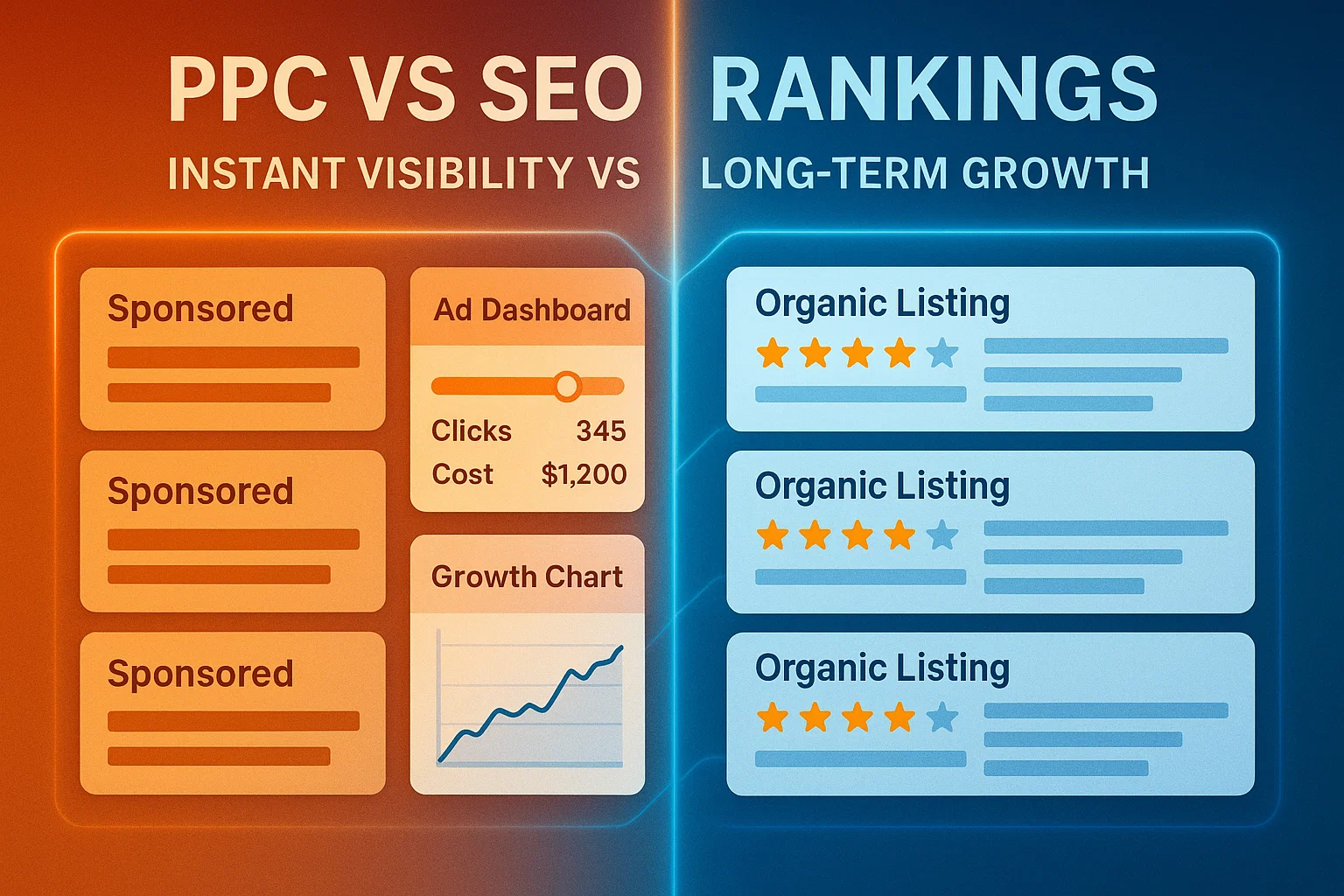
PPC rankings are determined instantly through Google Ads auctions based on your bid, Quality Score, and ad relevance, while SEO rankings depend on long-term organic factors such as content quality, backlinks, and user experience. PPC gives immediate visibility, whereas SEO requires time but delivers sustainable, cost-efficient results.
Key Takeaways
-
 PPC rankings are instant and depend on bidding, Quality Score, and ad relevance.
-
SEO rankings rely on long-term factors like content quality, backlinks, and user experience.
-
PPC delivers quick visibility but requires ongoing budget.
-
SEO takes longer but generates sustainable, lower-cost traffic.
-
Combining PPC + SEO offers maximum SERP coverage and stronger overall ROI.
What Determines PPC Ranking? (Google Ads Auction Explained)
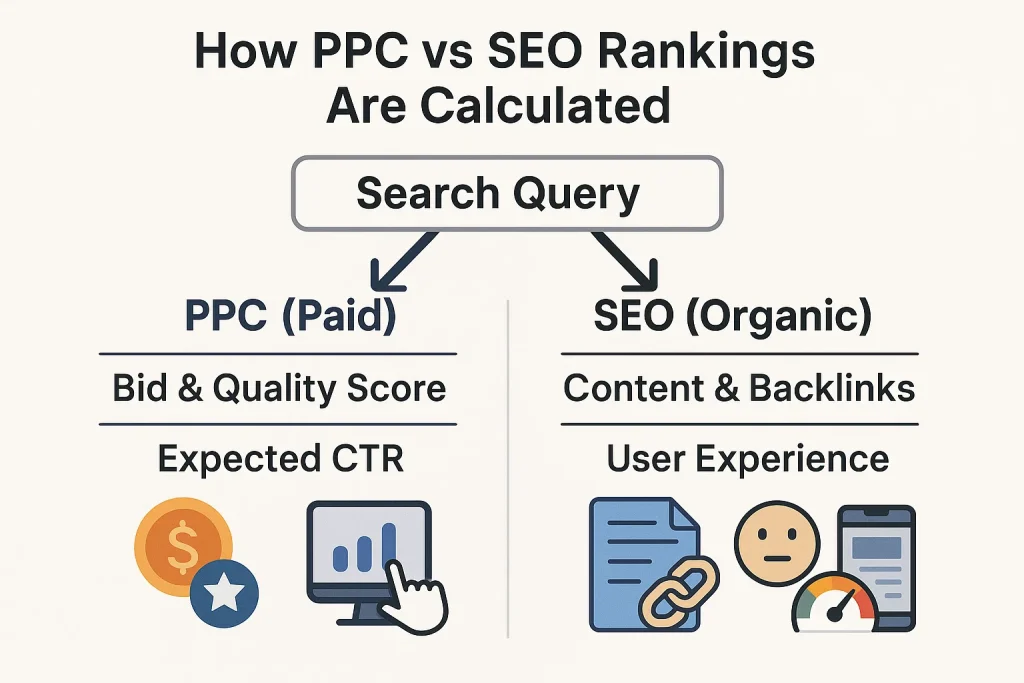
PPC ranking is controlled by Google’s real-time auction system. Every time someone searches, Google evaluates your maximum bid, Quality Score, and expected impact of your ad to decide your ad position. Unlike SEO, PPC placement can change instantly based on competitor bids and ad performance.
Key PPC Ranking Factors:
- Bid Amount: Higher bids increase visibility potential.
- Quality Score: Google measures ad relevance, CTR history, and landing-page experience.
- Expected CTR: Google predicts how likely users are to click your ad.
- Ad & Landing Page Relevance: Better alignment equals better ranking.
What Determines SEO Ranking? (Google Organic Algorithm Explained)
SEO ranking is based on Google’s algorithm, which evaluates hundreds of signals to decide whether your page is the most helpful, relevant, and trustworthy answer for a search query. Unlike PPC, you cannot pay to appear higher; you must earn rankings through consistent quality and authority.
Core SEO Ranking Factors
Content Quality & Relevance: Google rewards pages that thoroughly answer the searcher’s question, offer unique insights, and deliver clear, structured information. Content must align with search intent and provide real value to users.
Backlinks & Domain Authority: Links from reputable websites act as “votes of trust.” The more high-authority, relevant sites linking to you, the more confident Google is in your credibility—directly improving your rankings.
E-E-A-T (Experience, Expertise, Authoritativeness, Trustworthiness): Google prioritizes websites that demonstrate real expertise and experience. Pages supported by professional knowledge, trustworthy sources, or personal experience rank higher, especially for competitive or sensitive topics.
Page Speed & Core Web Vitals: Fast-loading pages improve user satisfaction and reduce bounce rates. Google measures performance metrics like LCP, CLS, and FID; sites meeting these benchmarks receive a ranking advantage.
User Engagement & Behavior Signals: Google evaluates how users interact with your page. High dwell time, low bounce rate, and strong click-through rates indicate that your content satisfies users, boosting your ranking potential.
Mobile Friendliness & Technical SEO: Because over 60% of searches happen on mobile, Google uses mobile-first indexing. Responsive design, clean site architecture, structured data, and optimized internal linking all contribute to stronger rankings.
PPC vs SEO Ranking — Core Differences
| Aspect | PPC Ranking (Paid Search) | SEO Ranking (Organic Search) | Notes / Data Points |
| How ranking is decided | Determined by Google Ads auction: bid amount, Quality Score, expected CTR, and ad relevance. | Determined by Google’s organic algorithm: content quality, relevance, backlinks, UX, and many other signals. | PPC = auction-based; SEO = algorithm-based. |
| Speed of visibility | Ads can show almost immediately after campaign activation. | Ranking improvements usually take weeks to months, depending on competition and authority. | Industry consensus: PPC = fast, SEO = slower but compounding. |
| Cost model | Pay-per-click (PPC): every click costs money; CPC varies by industry and keyword competitiveness. | No cost per click; main costs are content, tools, and ongoing optimization. | PPC spend stops → traffic stops. SEO keeps bringing traffic if you maintain rankings. |
| Stability of ranking | Positions can change quickly as competitors adjust bids or improve ads. Stopping spend = losing visibility. | Good SEO rankings are generally more stable and can last for months or years with upkeep. | PPC = volatile; SEO = more durable. |
| Placement on SERP | Ads appear above organic results and are labeled “Sponsored.” | Organic results appear below ads, but dominate non-ad clicks. | Studies show the #1 organic result earns ≈27.6% CTR on average. |
| User trust & perception | Some users skip ads intentionally; ads work best for high-intent, commercial queries. | Organic listings are often seen as more trustworthy and unbiased because they’re earned, not bought. | Multiple marketing surveys indicate users generally trust organic more than ads. |
| Best use case | Ideal for immediate traffic, launches, tests, and time-sensitive offers. | Ideal for long-term growth, authority building, and lowering acquisition costs. | Many brands use PPC for short-term wins and SEO for long-term compounding results. |
| Long-term value | Stops the moment you pause or reduce ad spend. | Keeps delivering traffic as long as you maintain quality and relevance. | SEO is typically more cost-efficient over the long term. |
Which Delivers Better ROI — PPC or SEO?
PPC and SEO can both deliver strong returns, but they perform very differently depending on the business model, competition, and marketing goals. PPC delivers fast conversions because ads appear immediately, while SEO often provides stronger long-term ROI because organic traffic does not require continuous spending.
How PPC Performs in Terms of ROI
- Short-term, immediate returns: PPC is ideal when you need results quickly — such as product launches, high-intent keywords, or urgent lead generation.
- ROI varies widely by industry: Clicks in competitive industries (law, insurance, finance) can be significantly more expensive due to fierce bidding. This affects ROI and requires constant optimization.
- Great for data-driven decisions: PPC provides instant feedback: impressions, clicks, conversion rates, and costs. This data helps businesses test messaging, landing pages, and keywords before investing heavily in SEO.
How SEO Performs in Terms of ROI
- Stronger long-term returns: Once a page ranks, ongoing traffic is free, making SEO a more cost-efficient channel over time.
- Compounding growth effect: High-quality content continues attracting clicks, backlinks, and engagement — increasing authority and lowering acquisition costs month over month.
- Best for brand visibility: SEO builds trust and credibility because users prefer organic results. Even Google’s own SERP studies show the first organic result receives the majority of clicks.
Which One Truly Wins?
- Choose PPC: if you need fast traffic, want to test offers, or operate in a time-sensitive niche.
- Choose SEO: if you’re building sustainable traffic, authority, and long-term cost efficiency.
- Best Strategy: GMost top-performing companies use both, leveraging PPC for quick wins and SEO for long-term dominance.
When to Use PPC (Best Situations)
PPC is the best choice when speed, precision targeting, or immediate conversions matter. Because ads appear instantly and can target users based on keywords, location, device, audience behavior, and more, PPC is ideal for short-term or high-intent scenarios.
Best Times to Choose PPC
When you need immediate traffic and leads, PPC campaigns start delivering impressions and clicks as soon as they go live, making them perfect for businesses that need fast results or want to fill a pipeline quickly.
1. When launching a new product or service. SEO takes time to build authority. PPC allows you to get visibility even before your organic presence grows.
2. When targeting high-commercial-intent keywords. Keywords like “buy now,” “near me,” or industry-specific service searches tend to convert well through paid ads.
3. When running seasonal or time-sensitive promotions. Holiday sales, limited-time offers, and event-based promotions perform well in PPC since you can turn campaigns on/off instantly.
4. When testing new landing pages or offers. PPC’s real-time feedback lets you validate which messaging, visuals, and pricing work best before scaling them into your long-term SEO strategy.
5. When the competition is too strong for quick SEO wins. In industries dominated by large high-authority sites, PPC can help you gain visibility while your SEO foundation is still being built.
When to Use SEO (Best Situations)
SEO is the best choice when your goal is to build long-term visibility, reduce acquisition costs, and become a trusted authority in your industry. It compounds over time, making it one of the most reliable and scalable marketing channels.
Best Times to Choose SEO
- When you want sustainable, long-term traffic. SEO is ideal when you want consistent visibility without paying for every single click. Once rankings stabilize, organic traffic continues to flow with minimal recurring cost.
- When building brand authority and trust matters. Ranking organically sends a strong signal of credibility. Users naturally trust organic results more than ads, especially in research-heavy niches like B2B, healthcare, finance, education, and services.
- When you want to lower customer acquisition cost (CAC). Unlike PPC, where costs increase as competition rises, SEO becomes more cost-effective over time because earned rankings continue to attract traffic without bidding wars.
- When you’re targeting informational or research queries. Many early-stage keywords (“how to…”, “best…”, “what is…”) have lower commercial intent but build your funnel. SEO content captures users early, building trust until they’re ready to convert.
- When your business benefits from evergreen content. Guides, tutorials, comparisons, FAQs, and resource pages can bring traffic for months or years with proper optimization.
- When your competitors rely heavily on paid ads. If others depend on PPC alone, strong SEO can help you win organic market share and reduce their visibility over time.
PPC + SEO Together for Maximum Visibility
Using PPC and SEO together creates a powerful, multi-channel search strategy. While PPC delivers instant results and precise targeting, SEO builds long-term authority and reduces costs. When both channels run simultaneously, businesses gain higher visibility, more click opportunities, and stronger conversion performance.
Why Combining PPC and SEO Works Best
- You dominate more SERP real estate. Appearing in both paid and organic results increases overall brand presence and trust. Users see your brand multiple times, making them more likely to click.
- PPC provides instant data that improves SEO. Search term data, CTRs, conversion insights, and high-performing keywords from Google Ads can guide content strategy and SEO keyword selection.
- SEO reduces long-term costs while PPC maintains flexibility. SEO keeps generating traffic year-round, and PPC helps fill gaps, run promotions, or target competitive keywords that SEO cannot win quickly.
- Higher total clicks and conversions. When users see the same brand in both ad placements and organic results, they trust it more, resulting in better click-through rates and improved conversion performance.
- Better testing and optimization across channels. You can test headlines, descriptions, value propositions, and offers through PPC before committing to them long-term in SEO content.
- PPC covers short-term needs while SEO builds long-term stability. Strong SEO ensures sustainable visibility, while PPC keeps your funnel active during seasonal shifts, algorithm updates, or competitive surges.
Stats Comparison Table — PPC vs SEO Ranking Factors
| Ranking Factor | PPC (Paid Search) | SEO (Organic Search) | Verified Notes / Safe Statistics |
| How rankings are calculated | Google Ads auction: bid, Quality Score, expected CTR, ad relevance. | Google algorithm: content quality, backlinks, experience, page speed, mobile usability, user engagement. | PPC = real-time auction; SEO = algorithm-based relevance. |
| Time to see results | Immediate visibility once ads are active. | Often several weeks to several months for meaningful ranking improvements. | Supported by SEMrush & Search Engine Journal. |
| Cost per click | Every click has a cost; CPC varies widely by industry & competition. | No per-click cost; investment is in content, technical SEO, and optimization. | PPC CPC ranges differ across markets; no universal number applies. |
| Click-through behavior | Ads receive fewer total clicks than organic results overall but can convert well for high-intent keywords. | The #1 organic result averages a 27.6% CTR, according to Backlinko’s data. | Organic results attract the majority of total clicks. |
| User trust | Some users skip ads; trust depends on ad relevance and search intent. | Users generally trust organic results more, especially for research-driven queries. | Supported by surveys from HubSpot & Search Engine Land. |
| Ranking stability | Fluctuates instantly based on competitor bids, budget, and ad quality. | More stable once strong rankings are achieved, though still influenced by updates and competition. | SEO provides steadier long-term visibility. |
| Long-term value | Stops immediately when ad budget ends. | Continues delivering traffic with consistent optimization. | SEO is widely considered a long-term investment channel. |
Why Choose SEO Specialist USA for SEO & PPC Management
Whether you’re building long-term organic visibility or need fast PPC results, SEO Specialist USA helps you grow with data-driven strategies, transparent reporting, and personalized support. We combine technical expertise, keyword intelligence, and conversion-focused optimization to deliver measurable growth for businesses of all sizes.
What Makes SEO Specialist USA Different?
We focus on ROI, not vanity metrics. Every campaign, SEO or PPC is designed to increase leads, conversions, and revenue, not just rankings.
Tailored strategies for your business goals. No generic templates. We build custom SEO roadmaps and PPC campaigns around your audience, industry, and competitive landscape.
Transparent reporting & real data insights. You always know what’s working, what’s improving, and where we’re scaling next.
Strong technical + creative expertise. From technical SEO fixes to optimized landing pages and high-quality content, we ensure your entire search presence performs at peak level.
Seamless PPC + SEO integration. We use PPC data to accelerate your SEO results and use SEO insights to reduce your PPC costs, giving you the best of both worlds.
Get Started with SEO Specialist USA
Ready to grow faster? Choose your next step:
Final Verdict on PPC vs SEO Rankings
PPC and SEO serve different purposes but complement each other well. PPC offers instant visibility and is ideal for urgent, high-intent conversions, while SEO builds long-term authority and sustainable traffic. Businesses achieve the strongest results by using PPC for immediate growth and SEO for lasting, cost-efficient visibility. Together, they create a powerful search strategy that maximizes reach, trust, and profitability.
FAQs: PPC vs SEO Ranking Differences
Is PPC ranking easier than SEO ranking?
Yes, PPC ranking is easier because you can appear instantly by entering Google’s ad auction. However, sustaining rankings requires continuous spending. SEO takes longer and is harder to earn, but provides more stable and cost-effective long-term visibility.
Why does SEO take longer than PPC to achieve results?
SEO rankings depend on building trust, authority, and relevance over time. Google evaluates content quality, backlinks, user experience, and many other signals. PPC bypasses these steps because placements are determined by bids and ad quality, making results immediate.
Does PPC help improve SEO ranking?
No, running PPC campaigns does not directly influence organic rankings. However, PPC can indirectly support SEO by generating data, improving brand exposure, testing keywords, and increasing traffic that helps refine long-term SEO strategies.
Which option provides better-quality traffic: PPC or SEO?
It depends on user intent. PPC often attracts high-intent buyers looking to take action immediately. SEO attracts broader audiences researching, comparing, and learning. For long-term growth and trust-building, SEO traffic tends to be more sustainable.
Can I rely on PPC alone without doing SEO?
You can, but it becomes expensive long-term because PPC stops producing results when your budget stops. SEO reduces customer acquisition cost over time and provides stable visibility, making it risky to rely on PPC alone.
Should small businesses choose PPC or SEO?
Small businesses benefit from using both. PPC delivers quick leads when needed, while SEO builds long-term authority and lowers marketing costs. The right mix depends on your budget, competition, and urgency for results.
Is combining PPC and SEO better than choosing one?
Yes. Using both creates stronger search visibility, more total clicks, and better brand recall. PPC helps with immediate conversions, while SEO builds long-lasting authority, together offering the most powerful and balanced strategy.